Chimney Flashing: The Most Common Source of Roof Leaks
If your roof is leaking, the chimney is the first place to look. Here's why chimney flashing fails, what it looks like when it does, and how we fix it.
Want a straight answer about your own roof?
Free inspection, written report, no sales pitch. We cover Johnson, Douglas, Wyandotte and Leavenworth counties.
Let's be real. If we had to bet on where a roof leak is coming from, we'd put money on the chimney nine times out of ten. It's the most common source of leaks on residential roofs, and it's not even close. The reason is simple: a chimney is a big brick box punching through your roof, and the only thing keeping water out of that junction is a few pieces of sheet metal and some sealant. When any of that fails, water finds a way in.
How chimney flashing works
There are two layers of flashing around a chimney. Step flashing goes up the sides. It's a series of L-shaped metal pieces that interweave with each row of shingles. Counter flashing sits on top, embedded into the mortar joints of the chimney, and folds down over the step flashing. At the base of the chimney on the uphill side, there's a piece called the apron. On the downhill side, there's a cricket or saddle, a small peaked structure that diverts water around the chimney instead of letting it pool behind it.
A roof, from the outside in
Outside
- ShinglesSheds water, takes the hail hits
- UnderlaymentSynthetic sheet, second line of defense
- Ice and water shieldSealed membrane at the eaves and valleys
- Roof deckThe plywood everything nails into
- Vented atticAir has to keep moving through here
Inside your home
Why it fails
- Sealant dries out and cracks: this happens fastest on the south-facing side where sun exposure is greatest
- Mortar joints deteriorate and the counter flashing pulls loose
- Thermal expansion: the chimney and the roof move at different rates with temperature changes
- The cricket or saddle wasn't installed in the first place, so water pools on the uphill side
- Original installation was done with roofing cement instead of proper step and counter flashing
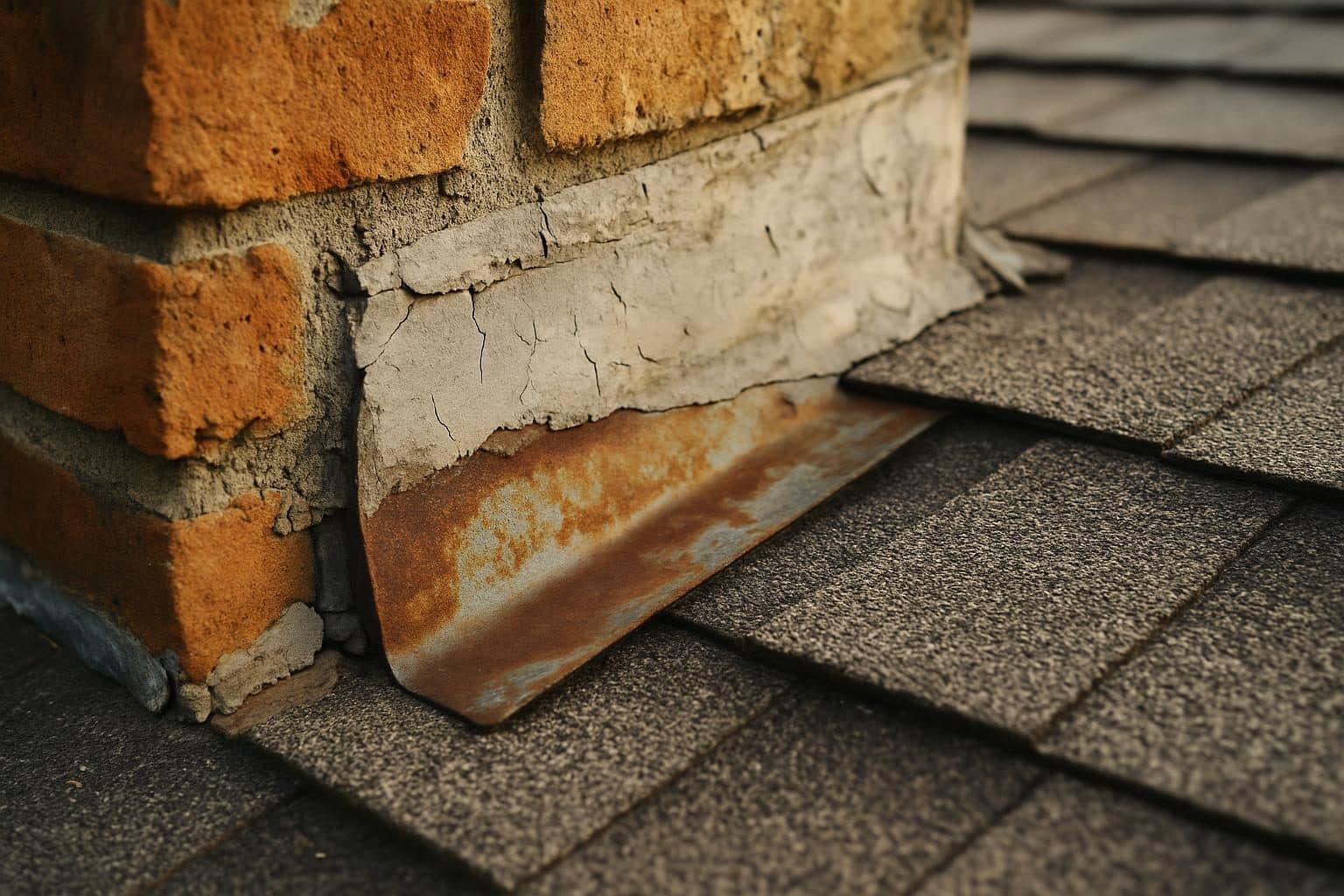
That last one is more common than it should be. We tear into a leak around a chimney and find that somebody just gooped a bunch of tar or roofing cement around the base and called it a day. That stuff works for a year or two, then it cracks and separates, and you're right back where you started, except now there's dried tar everywhere making the real repair harder.
How we fix it right
A proper chimney flashing repair means removing the old material, installing new step flashing woven into the shingles, cutting reglets into the mortar joints for counter flashing, and sealing everything with high-quality polyurethane sealant. Not roofing cement. If the chimney doesn't have a cricket and it should (any chimney wider than 30 inches on the uphill side needs one per code), we build one. The repair typically runs $400 to $1,200 depending on what we find when we open it up.
If you've got water stains on the ceiling near your fireplace or you can see daylight around your chimney from the attic, don't wait on it. Water damage gets expensive fast. Give us a call at (913) 954-4501.
Want a straight answer about your own roof?
Free inspection, written report, no sales pitch. We cover Johnson, Douglas, Wyandotte and Leavenworth counties.